Posts

A conceptual machine for cloning a human driver

Image
If anything else, a Machine Learning practitioner has to get a global view and think on how far our conceptual machines can go. This is a little tale of my recent experience with Deep Learning. To start with, say that I am enrolled in the Udacity’s nanodegree inSelf Driving Car Engineer . Here we are learning the techniques needed for building a car controller capable of driving at the human level. The interesting part of the course (to be read as where one truly learns) is in the so called projects: these are nothing but assignments in which the student has to solve a challenging task, mainly by using Convolutional Neural Networks (convnets), the most well-known Deep Learning models. So far, the most mind-blowing task and the focus of this entry is project 3, were we have to record our driving behavior in a car simulator and let a convnet to clone it and successfully generalize the act of driving. It is remarkable that a convnet learns to control the car from raw color images jointly...
High Performance Computing, yet another brief installation tutorial

Today’s mid- and high-end computers come with a tremendous hardware, mostly used in video games and other media software, that can be exploited for advanced computation, that is: High Performance Computing (HPC). This is a hot topic in Deep Learning as modern graphic cards come with huge streaming process power and large and quick memory. The most successful example is in Nvidia’s CUDA platform. In summary, CUDA significantly speeds up the fitting of large neural nets (for instance: from several hours to just a few minutes!). However, the drawbacks come when setting up the scenario: it is non-trivial to install the requirements and set it running, and personally I had a little trouble the first time as many packages need to be manually compiled and installed in a specific order. The purpose of this entry is to reflect what I did for setting up Theano and Keras with HPC using an Nvidia’s graphic card (in my case a GT730) using GNU/Linux. To do so, I will start assuming a clean Debi...

Beyond state-of-the-art accuracy by fostering ensemble generalization

Image
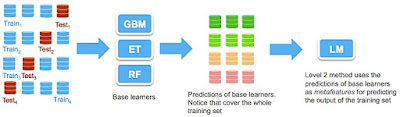
Sometimes practitioners are forced to go beyond the standard methods in order to gain more accuracy with their models. If one analyzes the problem of rocketing accuracy, ensembling is a good starting point. However, the trick lies in getting enough generalization from feature space.  In this regard, ensemble generalization--do not confuse with classic or "standard" ensemble methods such as Random Forest or Gradient Boosting-- is the right path to follow, however complex. The idea is to combine predictions from "base learners" to train a second stage regressor, using these predictions as metafeatures. The trick is to use a J-fold cross-validation scheme and use always the same data partitions and seed. This kind of ensemble is often called stacking --as we "stack" layers of classifiers. Let’s do an example: suppose that we have three base learners: GBM, ET, and RF. Then assume we have a LM as level 2 learner. First we divide the training data into ...

Presenting a Conceptual Machine Capable of Evolving Association Streams

The increasing bulk of data generation in industrial and scientific applications has fostered practitioners’ interest in mining large amounts of unlabelled data in the form of continuous, high speed, and time-changing streams of information. An appealing field is association stream mining, which models dynamically complex domains via rules without assuming any a priori structure. Different from the related frequent pattern mining field, its goal is to extract interesting associations among the forming features of such data, adapting these to the ever-changing dynamics of the environment in a pure online fashion--without the typical offline rule generation. These rules are adequate for extracting valuable insight which helps in decision making. It is a pleasure to detail Fuzzy-CSar, an online genetic fuzzy system (GFS) designed to extract interesting, quantitative rules from streams of samples. It evolves its internal model online, being able to quickly adapt its knowledge in the ...

Kagglers: another LHC Challenge!

I am glad of sharing some very motivating news: after a little bit more than year, Kaggle hosts a new CERN/LHC competition ! This time it comes from the tau disintegration into three muons. Again, the challenge consists of identifying the pattern from both real and simulated data to identify this rare phenomenon. The training data set consists of 49 distinct real-valued features plus the signal (i.e., background noise and the proper event). This time I am using Python with Scikit learn, Pandas and XGBoost (this latter one by far my favorite ensemble package; also available for R!) and I have to confess that is much easier when you do not have to program everything from scratch (as I usually do in C/C++ or Java), and that I have more time to think in new ways of solving the problem from a pure data scientist view. However, I really adore making use of use my own programs (I ended up 24th out of 1691 in the Forest Cover Type challenge using my own Extra Trees/Random Forest progra...

A Vectorized Version of the Mighty Logistic Regressor

Image
Neural nets, with their flexible data representation capable of approximate any arbitrary function, are in a new renaissance with the development of Deep Leaners. These stack many layers (typically dozens of quasi-independent layers) of traditional neurons to achieve something very remarkable: self detection of important features from input data. The application of Deep Learning is not restricted to raw classification or regression; these family of techniques are applied to much broader fields such as machine vision and speech recognition. Recent advances went much further and combined a Deep Learning architecture with a Reinforcement Learning algorithm generating a computer program capable of beating classic Atari video games without being explicitly programmed for this task, scoring as a top human player. It is not surprising, therefore, that they appear in the last Nature’s cover (vol. 518, Num. 7540, pp. 456-568) . But how do they work? First, one must take a close look to the hum...

Data Analytics Plus Big Data: A Win-win Strategy

We live in a dynamic world where new technologies arise, dominate for a brief blink of an eye and then fall to oblivion rapidly. A part from the academia domain, it is interesting to check what are the current trends in the industry. Or even better: see the whole picture without discriminating. In this regard, a nice analytics tool is found in Google Trends, which allow us to track our terms of interest. The following chart shows the search interest for Machine Learning and Data Analytics . In a similar scale I depicted the search interest for Data Analytics and Big Data . As it is clearly noticeable, knowing both disciplines can open many doors in the industry. Finally, as top and also rising queries, Hadoop is the most popular term.

Gradient Boosting: Fostering accuracy even further

Image
As in many real-world situations, union makes algorithms stronger. With this philosophy in mind, ensemble methods combine several weak classifiers into a massive one---in terms of accuracy. In the last post we learnt a primer with Random Forest . Therefore, the next cornerstone is gradient boosting. I mentioned Gradient Boosting many times in this blog, but I only commented the fundamental ideas, without discussing further the details. In this entry I will share my two cents. Let me introduce a little bit of history, first: recall the Kaggle-Higgs competition . The top scores in the leaderboard have been obtained by using distinct forms of gradient boosting, and XGBoost is the direct responsible of many of these. The question is, hence, how does this algorithm work ? Figure 1. A high-level description of the Gradient Boosting method I programmed. Click to enlarge. Informally, Gradient Boosting generates a sequence of classifiers in the form of an additive expansion, that i...

Toward ensemble methods: A primer with Random Forest

The Kaggle-Higgs competition has attracted my attention very much lately. In this particular challenge, the goal is to generate a predictive model out of a bunch of data taken from distinct LHC’s detectors. The numbers are the following: 250000 properly labeled instances, 30 real-valued features (containing missing values), and two classes, namely background { b } and signal { s }. Also, the site provides a test set consisting of 550000 unlabeled instances. There are nearly 1300 participants while I am writing this post, and a lot of distinct methods are put to the test to win the challenge. Very interestingly, ensemble methods are all in the head of the leaderboard, and the surprise is XGBoost , a gradient boosting method that makes use of binary trees.   After checking the computational horsepower of the XGBoost algorithm by myself, I decided to take a closer look at ensemble methods. To start with, I implemented a Random Forest , an algorithm that consists of many indep...

Boosting the accuracy rate by means of AdaBoost

Image
Several machine learning techniques foster the cooperation between subsolutions for obtaining an accurate outcome by combining many of them. Michigan-style LCSs are one of these families. However, the most well known are those that implement Boosting, and AdaBoost is the most successful of them (or, at least, the most studied one and the first to implement the ideas of Boosting). AdaBoost generates accurate predictions by combining several weak classifiers (also referred to as “the wisdom of the crowd”). The most outstanding fact about AdaBoost is that it is a deadly simple algorithm. The key of its success lies in the combination of many weak classifiers: these are very limited and their error rate is just slightly better than a random choice (hence their name). The typical implementation uses decision stumps (i.e., binary trees) that minimize the error between the prediction and the ground truth (that is, the desired outcome), so the classifiers have the form " if variable_...